01 · THE PAGE IS SILENT
About one in three pricing pages showed no visible price
Most audited pages gave an automated reader a clear price. About one in three did not. That same visible outcome can come from two different causes: a deliberate sales route or a missing/inaccessible price.
What the audited pricing pages showed
No visible price can have two causes
- About 4 in 10 — a deliberate choice: the business chose not to post a number, preferring instead to discuss it on a sales call, or it depends on usage or seat count (variable pricing).
- About 6 in 10 — missing or inaccessible: nobody chose this. The page simply doesn't give a usable price, even though a buyer is right there asking for one.
02 · THE WIDER WEBSITE
The rest of the website rarely fills the gap
We checked the wider website when a pricing page showed no clear price: the sitemap, the homepage's internal links, and two site-restricted searches for pricing-related terms — each candidate URL verified against our own live price-detection code, not read by eye. A number elsewhere was often a locale copy, an old path, a support article, or a narrow product page. A price somewhere else is not necessarily a useful answer to a general "how much?" question.
Why prices go missing
A person sees the price. An automated reader may not.
These examples show the access problem behind a smaller share of missing-price cases.


03 · AI STILL ANSWERS
A silent website does not produce a silent AI answer
We asked three AI assistants (ChatGPT, Claude, and Perplexity) the same plain question — "How much does {Brand} cost?", with web search turned on — about every website where no price appeared anywhere.
Did the response state a price anyway?
We counted a response as stating a price when it contained any stated currency figure ($, €, or £). Of the price-stating responses, 67.3% read as an exact price, 17.7% gave a starting price, and 15.0% gave a range — though that split is approximate: it comes from a stored 400-character excerpt of each response, not the full text, long enough to cut a number off mid-digit in at least one case (see finding 04), so treat the three shares as directional rather than final. The rate also varied by assistant, shown below. And removing websites with a price found elsewhere barely changed the pattern — the buyer can still receive a specific answer even when the official site provides no price to quote.
Stated a price anyway, by assistant
For example, a URL-shortening tool's real pricing page exists, but the price is rendered by JavaScript that a plain fetch never runs — a non-JS reader gets no usable number from the page itself, the same mechanism behind this report's own hero demo. Asked its price, Perplexity answered: "Has a free plan, and paid plans commonly start at $9.99/month for Pro, though some pricing aggregators list Pro at $16/month instead. Other listed tiers include Bulk at $83/month and Enterprise at $299/year." — citing capterra.com and saasworthy.com, not the company's own site.
For comparison, on pages where a price was visible, 96.7% of responses stated a price — only a little higher than 78.5%. A missing price barely slows AI down from stating a number; finding 06 looks at what visible pricing does change.
04 · WHY BUYERS CARE
That number may not be the answer your team intended
The answer can include your own website, outside sources, or a mixture of both. We counted the brand as cited when an answer linked to any page on the brand's domain, including subdomains — and across all 136 websites in the AI test, about one in three answers didn't cite it at all. When it wasn't cited, the most common substitute was a review or comparison site: G2, Capterra, TrustRadius, and similar sites account for about a quarter of every outside citation across the full test.
Most-cited outside sources (of 1,382 outside citations)
Bars scaled to G2's share, the largest — each label is the true % of all outside citations.
Even the single biggest outside source is under 5% — no one alternative dominates; it's spread thin across 737 different domains.
For example, asked about the price of a messaging app's premium tier, two of three assistants answered without citing the company's own site at all — citing instead a gray-market key-reselling marketplace, alongside unrelated blogs and a gaming-news site.
Separately, in about two out of five websites where we could compare answers, AI assistants gave different price numbers for the same product — we counted two assistants' prices as different when neither one's full list of mentioned prices shared a single number with the other's. The gaps themselves ranged from $0.01 to $9,126, with a median of $5. Rather than judge all 38 flagged cases by the size of that gap alone, we hand-checked every one, and found two distinct, equally real failures — plus some that aren't failures at all:
- 10 of 38: wrong number, right company. Two assistants named a different price for the same plan from the same brand — a factual pricing error.
- 6 of 38: wrong company entirely. At least one assistant answered about a different, unrelated business sharing the same name — the buyer doesn't even know they got an answer about the wrong business. If anything, this is the more serious failure of the two.
- 17 of 38: same brand, different plan. The assistants were comparing a different tier, billing period, currency, or customer segment of the same company — not a real disagreement, just unmatched detail.
- 4 of 38: not a real difference. The numbers are effectively identical (e.g. $10 vs. $9.99) and only count as "different" because of how strictly the comparison is made.
- 1 of 38: our own data error. A stored response was cut off mid-number, turning a real price into a false, much smaller one.
So the "2 in 5 disagree" figure is real, but it's two different kinds of AI failure — wrong number and wrong company — not one. For example, asked "How much does a live-streaming platform's subscription cost?", one assistant said "$4.99/month," a second also said "$4.99/month," and a third said "$5.99/month." The company's own help center confirms $5.99/month is correct — two of three assistants got it wrong, including one that cited the company's own domain directly, and another that answered about a different product sold under the same brand name instead of the tier that was actually asked about.
Not being cited and being wrong are connected: when the brand's own site wasn't cited, disagreement hit 72.7% of comparable answers, versus 34.9% when it was — about 2.1x — though the not-cited group is small (n=11). For a buyer, the price depends on which assistant they happen to ask; this shows that the numbers differed, not which one was wrong.
None of this requires a mistake on your site — just silence, which AI fills in without you, and your team absorbs the fallout.
No official price
The pricing page or wider website gives no clear price.
AI fills the gap
A buyer receives a specific number from an answer assistant.
The offer does not match
The plan, currency, period, or price differs when the buyer checks.
Trust moves backwards
The buyer has to ask, verify, complain, or leave without confidence.
05 · SEE IT FOR YOURSELF
What "AI fills the gap" actually looks like
Everywhere else in this report, examples are described, not shown — company names are removed throughout, by policy, regardless of size. But a rate is easier to argue with than a transcript. Below are three real conversations with three different assistants, each redacted only to remove the company's name and plan names that repeated it. Nothing else is edited.
The price is right. The sourcing isn't.
A subscription service's pricing page, asked of two assistants.
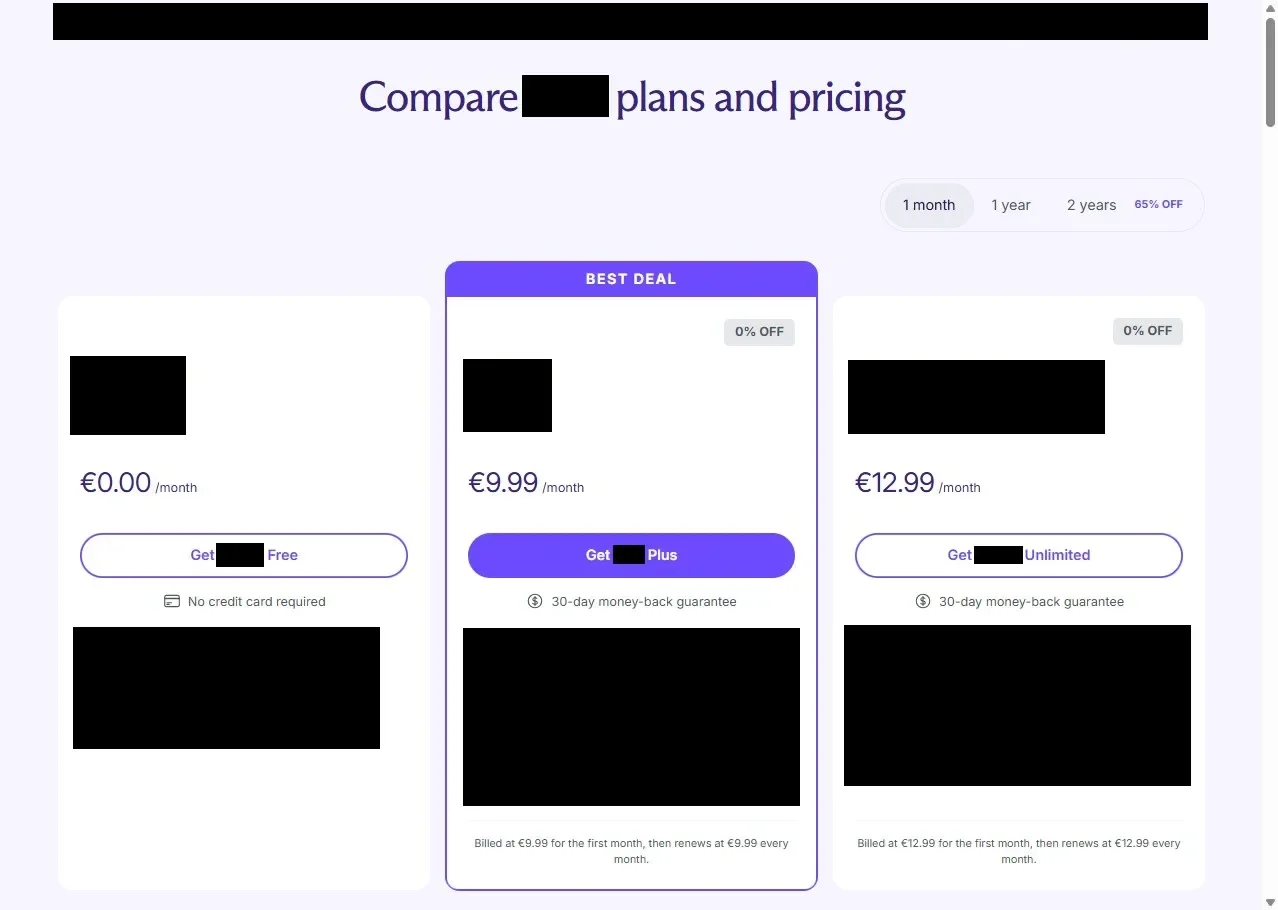
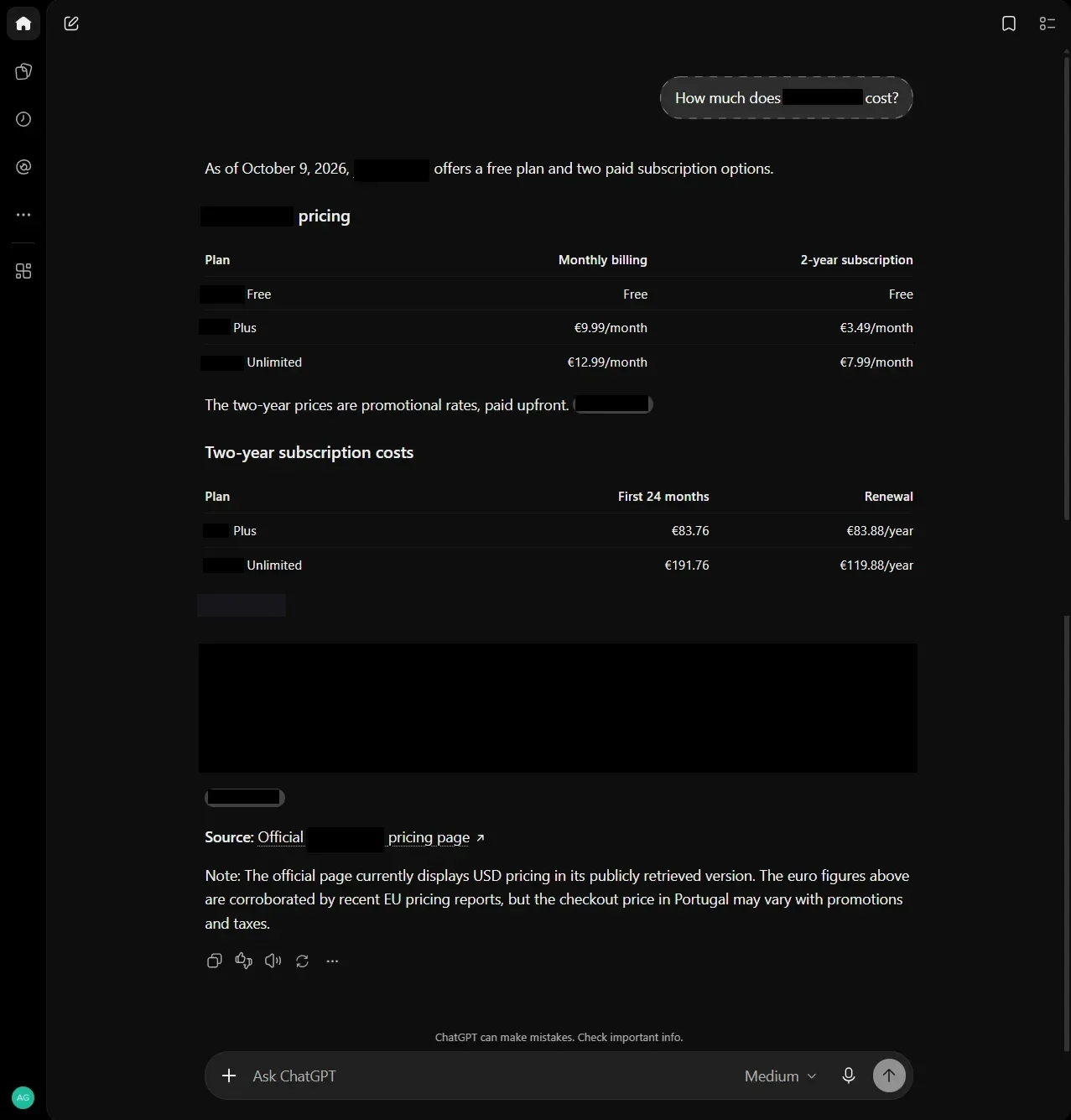
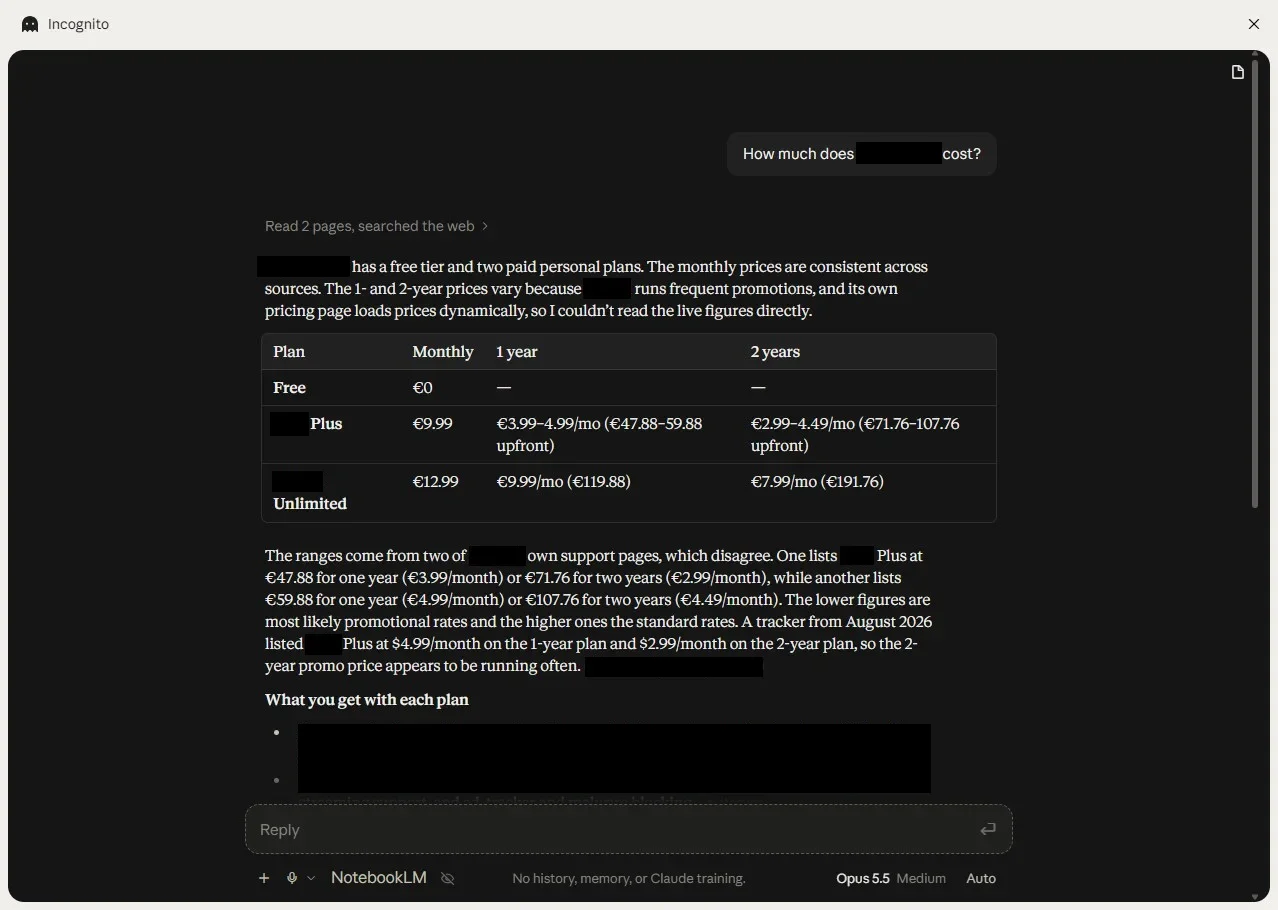
Neither assistant ever reads the real page — its price loads in through JavaScript, the same mechanism finding 02 measures at scale. ChatGPT works around that by citing "Official pricing page" as its source without actually using it: a footnote admits the page it fetched was priced in dollars, so the euro figures it displays came from somewhere else entirely, an unnamed "recent EU pricing reports." It then goes a step further and computes a number nobody asked for — a post-promo renewal rate, about €6.99 a month on the mid-tier plan — built on a table there's no way to check against the real page.
Claude is more upfront about not being able to read the page, and it shows: asked the same question, it quotes two of the company's own support pages that disagree with each other — €47.88 and €71.76 on one, €59.88 and €107.76 on the other, for the same mid-tier plan at one and two years — rather than picking a winner. That's why its answer is a range, €2.99 to €4.49 a month, instead of a single figure. ChatGPT's single figure, €3.49, happens to land inside that range. It isn't right because ChatGPT checked anything; it's right because the range was wide enough to catch it.
Both assistants get the plain monthly price exactly right, which is almost beside the point. The page only has to ask one more question than "what's the monthly price" — how does a promotion work, what happens after it ends — before neither assistant is actually looking at the real numbers to answer it.
One assistant lands on the right number. Neither one checked.
A career-tools subscription, asked twice.
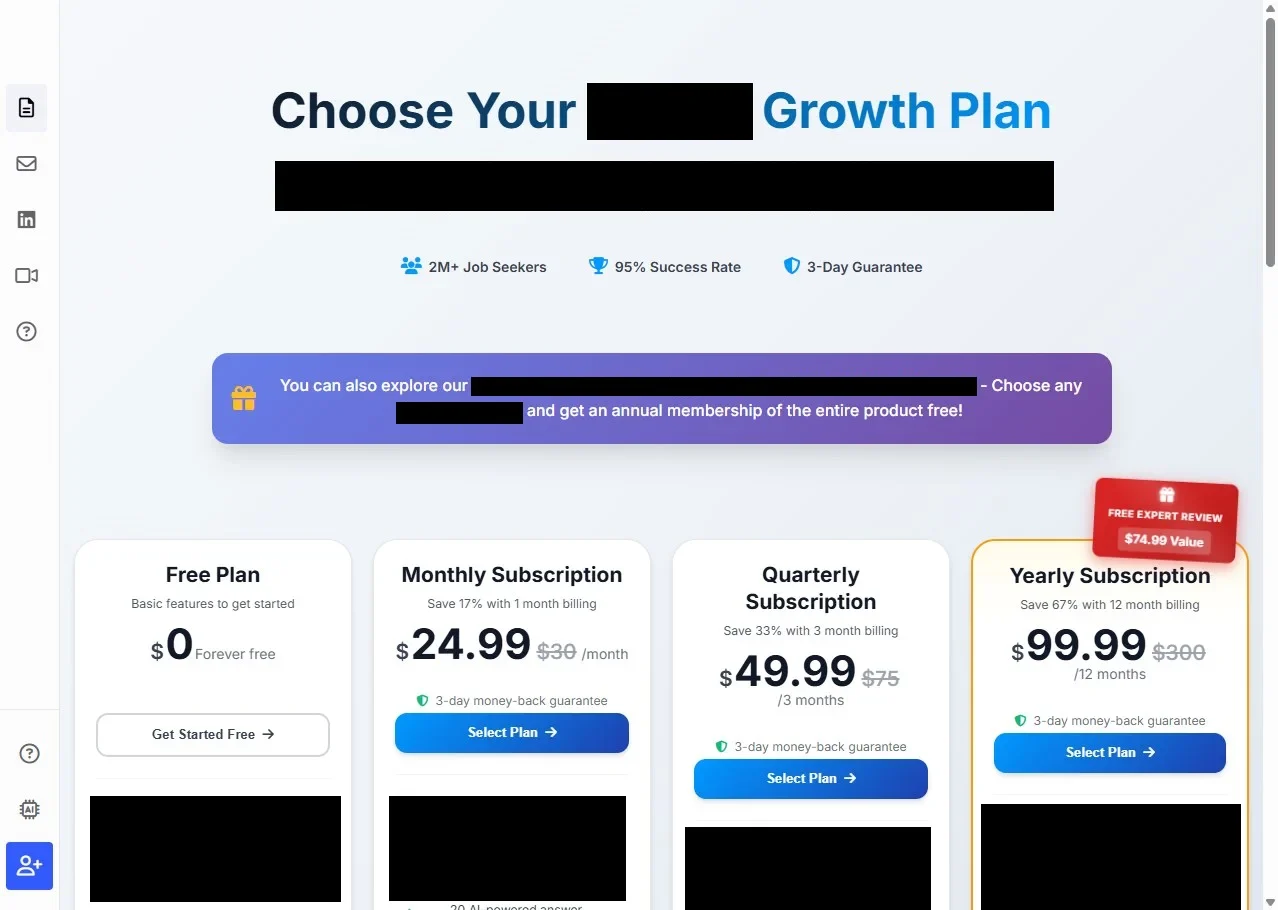
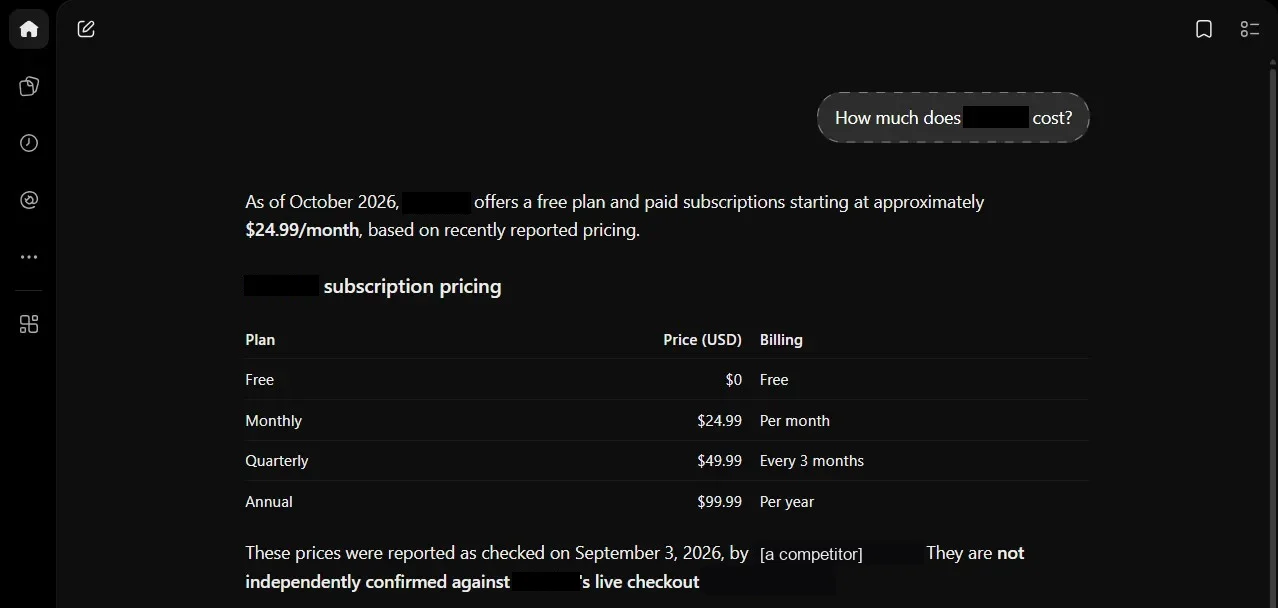
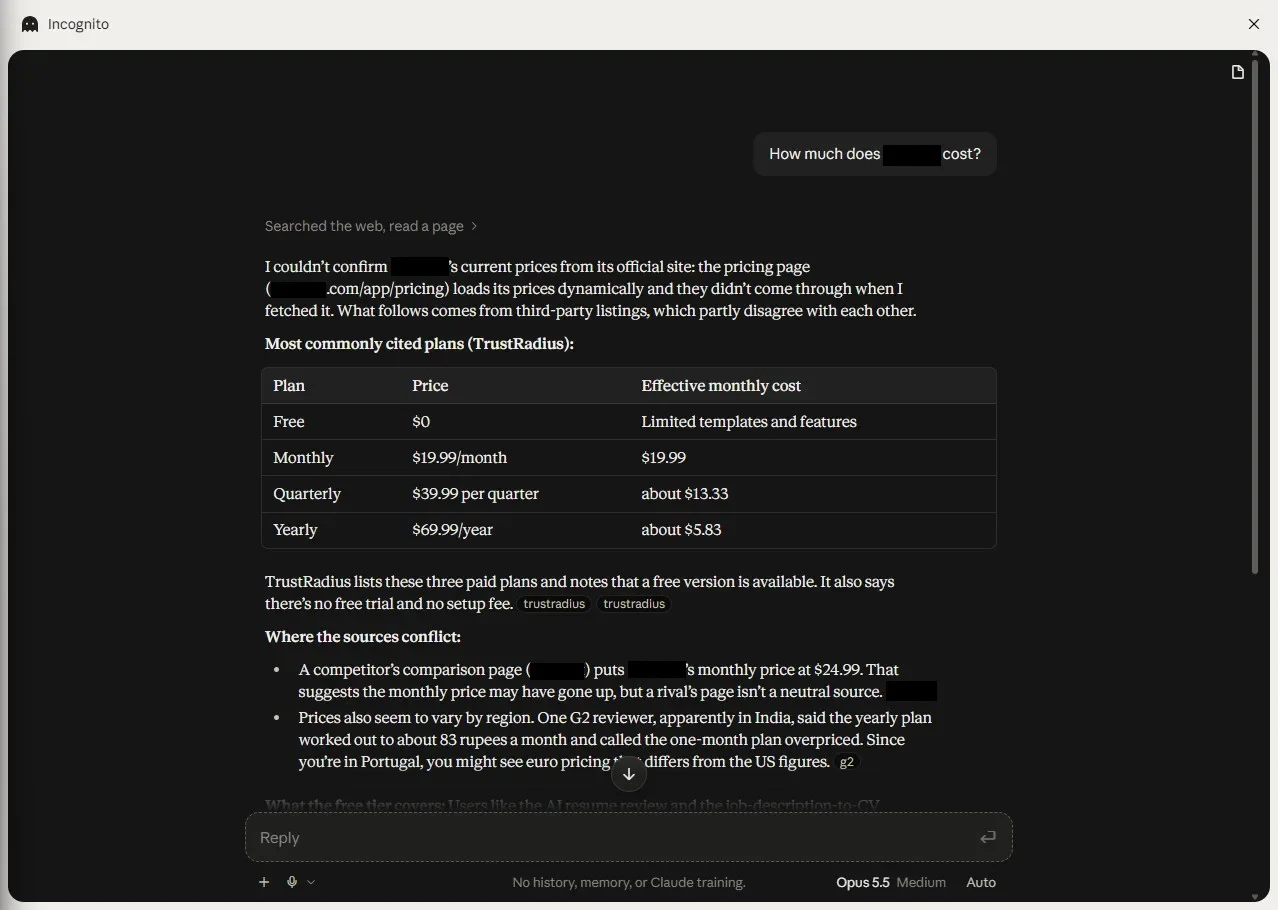
Neither assistant reads the real page here either. Claude says so outright: the pricing page loads its numbers in after the fact, and they never arrived when it tried to fetch them — the same mechanism finding 02 measures at scale. What happens next is the more interesting failure.
Asked to fill the gap, Claude finds a competitor's page quoting the correct price, and it says so — then talks itself out of using it, on the reasonable-sounding grounds that a rival's page isn't a neutral source. It goes with a third-party listing instead, one that's roughly 20% low across every tier. Asked to explain the gap between the two, it doesn't say one of its sources might just be out of date. It reaches for something more specific: the buyer is in Portugal, so maybe the price is simply different there from the figures it's quoting. The reasoning is careful at every step. It's wrong at the end anyway.
ChatGPT's number is the correct one — but only in the sense that it happens to match. It comes from an unnamed competitor's listing, dated more than a month before the question was asked, which ChatGPT itself flags as unconfirmed. Being right here took exactly as much verification as being wrong took for Claude: none. One assistant just happened to land on a better source.
Same JS wall as the other two. ChatGPT just doesn't let on.
Three clearly tiered plans — invisible to anything that can't run the page's JavaScript.
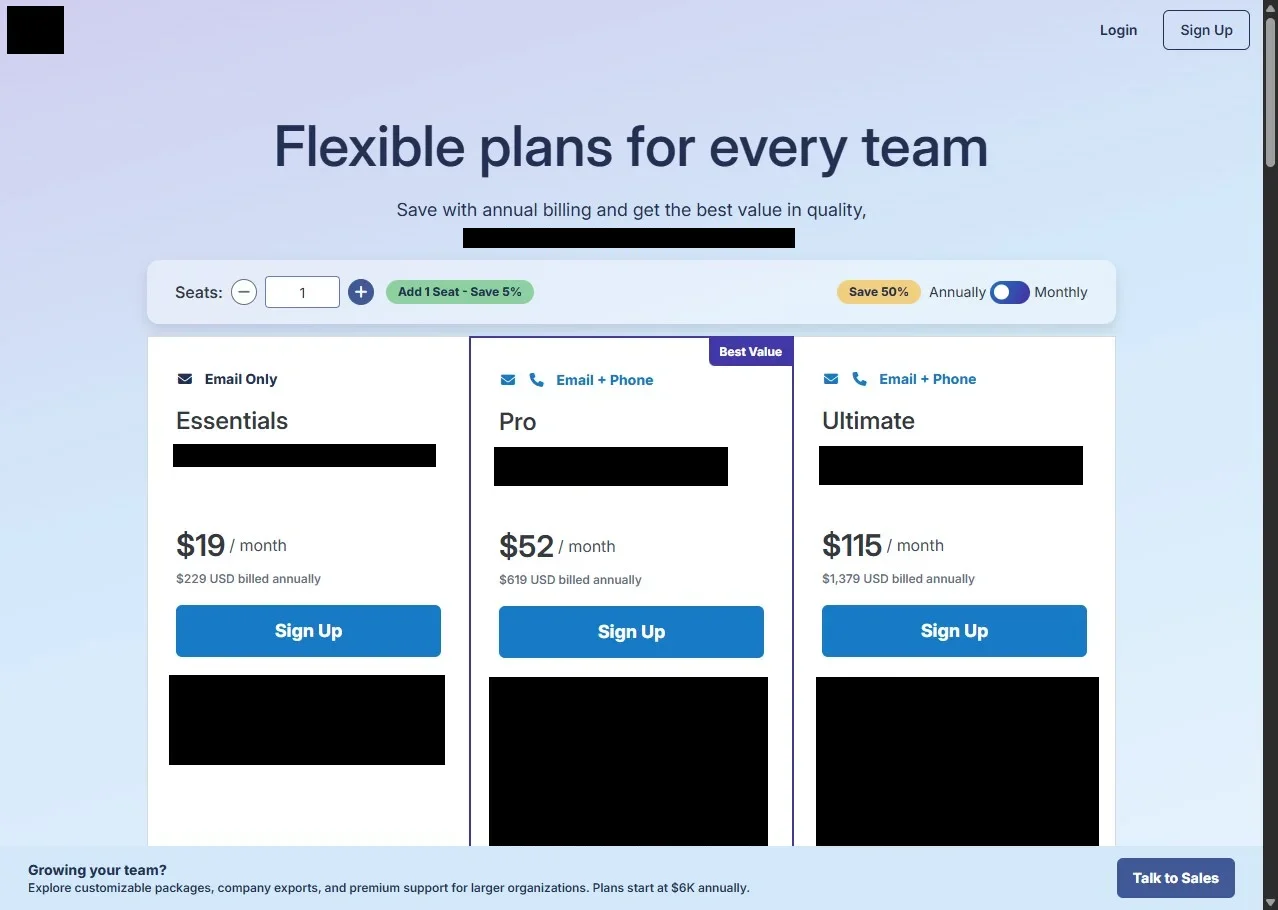
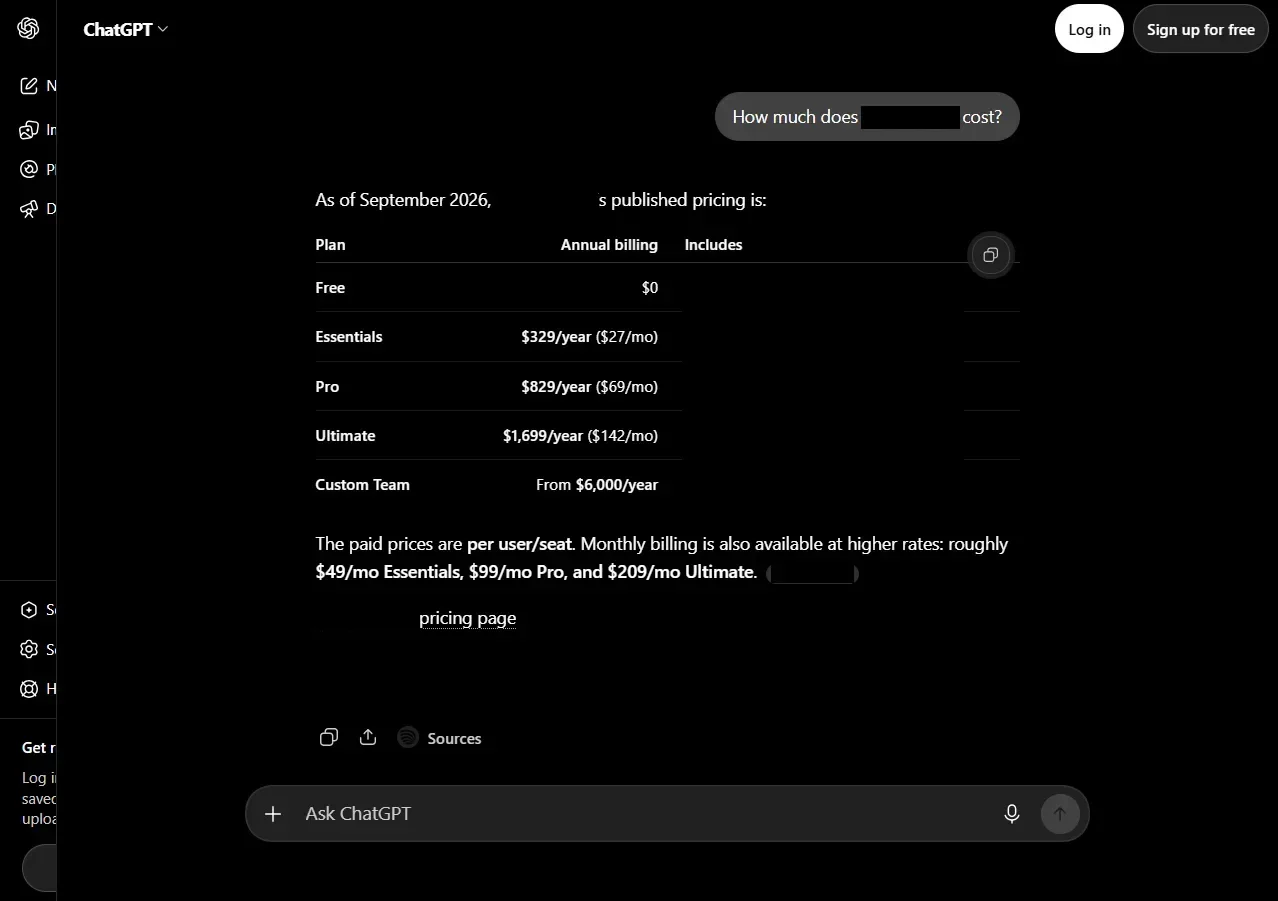
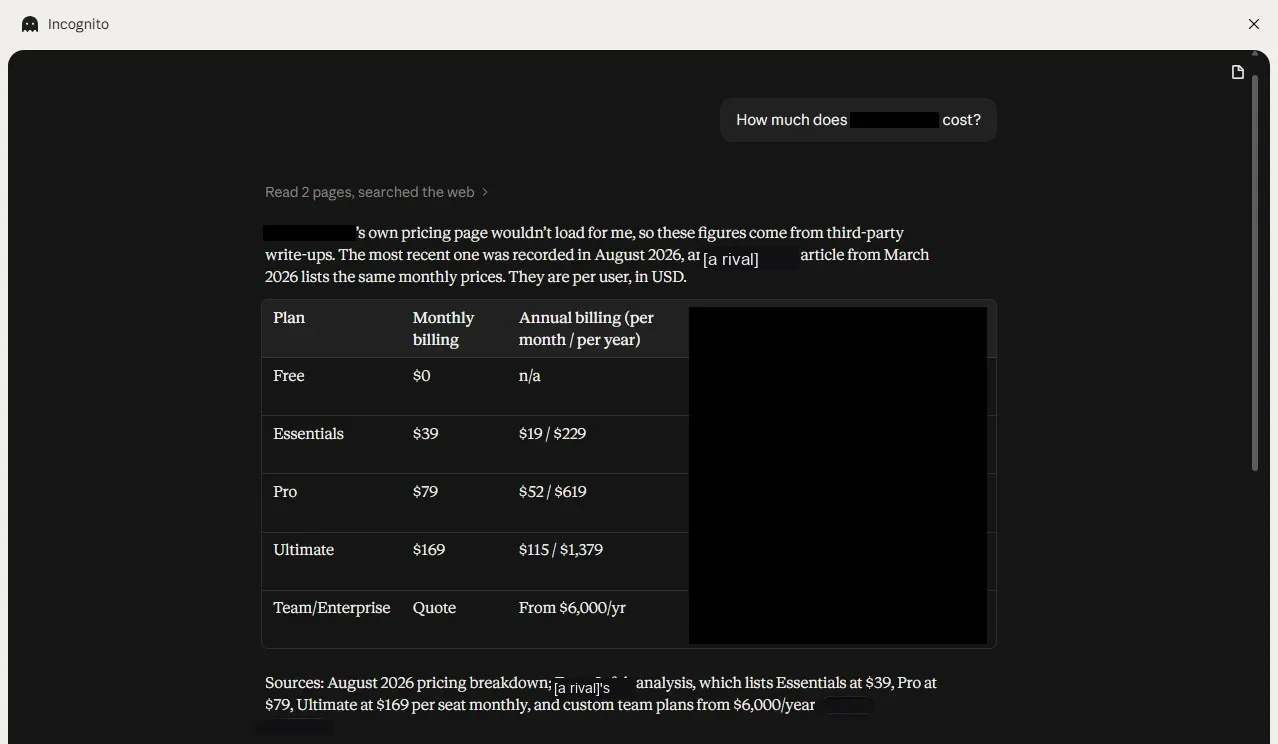
Neither assistant reads the real page — but only one says so. Claude states it outright: its own fetch failed, so everything that follows comes from third-party write-ups. ChatGPT never raises the possibility. It just answers, with total confidence: no "approximately," no caveat of any kind, just a table presented as current — and wrong on every tier it computes, both the annual-equivalent rate and the separate monthly rate it quotes for each plan.
Claude's table also lists two rates per plan, and the two halves have a very different relationship to the truth. The annual-billing column matches the real page exactly, tier for tier. The monthly-billing column next to it is sourced, by Claude's own account, to a competitor's analysis — the half nothing here can check, since the real page only ever showed its annual rate. Both columns are printed with the same confidence, though. A "save 50% annually" toggle on the real page does confirm a separate, higher monthly rate exists, so the shape of Claude's answer is right. Whether the specific number it gives is correct remains open.
The one figure both assistants get right is also the vaguest one on the page: a quoted, not computed, enterprise floor — "$6,000 a year and up." Everything more specific than that, every exact tier and every exact rate, is where they diverge from the real numbers, or from each other.
Two of these three cases share something else worth naming on its own: when the assistant couldn't read the real page, it didn't reach for a neutral source — it reached for a competitor's own content about the price.
06 · WHAT VISIBLE PRICING BUYS YOU
A price-visible sample shows how much of this is avoidable
We ran the identical 3-assistant question against a separate sample of 50 pages confirmed to show a usable price in their raw, bot-fetched HTML — the opposite case from everything above. The gap is dramatic.
Same test, two cohorts
No price anywhere (97–136 brands) vs. a price visible on the page (50 brands, a directional sample)
That last row is the same disagreement rate from finding 04, inverted: 39.2% different vs. 6.3% different. We hand-checked the price-visible sample's disagreements too — none were real conflicts, just billing-period mix-ups and one currency-detection miss where all three assistants actually agreed. The middle row hides a sharper split, though — see below.
Citation rate by assistant, on price-visible pages
Share of responses that did NOT cite the brand's own site, price-visible sample (n=50)
07 · WHAT TO DO
Give AI a pricing anchor you are willing to own
The right response depends on why the website is silent. You do not need to publish every plan. You do need to decide what information you want buyers and AI to repeat.
The practical test
- Ask an AI assistant what your product costs.
- Compare the answer with the price or context your team wants buyers to see.
- Fix the gap that matters: the strategy, the missing words, or the access path.
Check what AI can find about your pricing
See whether automated readers can access the pricing information your team wants buyers to repeat.
Analyze your site free08 · METHODOLOGY
Methodology and limits
- The page audit and website follow-up use different populations. Their percentages should not be added together.
- The answer result is a share of responses, not a share of companies with a correct price.
- Source overlap shows which websites appeared in citation lists. It does not prove which page supplied the price.
- The price comparison shows differing extracted numbers; we hand-checked all 38 flagged cases individually rather than judge them by gap size alone.
- The control-group comparison (finding 06) uses a 50-page sample, not the full scale of the main cohort — directional, not final.
- This was a single test run. It does not measure changes over time, rankings, sentiment, support volume, reviews, or conversion.
Cite this research
This report and its full data tables are archived on Zenodo with permanent DOIs.
- Report: Guelmann, A. (2026). The Invisible Price Tag. BeSeenByAI. DOI10.5281/zenodo.23282396
- Data tables: Guelmann, A. (2026). The Invisible Price Tag — Data Tables [Data set]. BeSeenByAI. DOI10.5281/zenodo.23282400
LicenseCC BY 4.0 Free to reuse and adapt, with credit.