A question we get a lot: why do I need a tool for AI visibility optimization? I can paste my page into ChatGPT and ask it what’s missing.
You can. And it will give you an answer. A confident, well-written answer full of reasonable advice.
The problem is the analysis behind it.
ChatGPT reviewing your page runs no analysis at all. It pattern-matches your page against advice that applies to pages in general. In other words, it’s generic.
Content Coverage runs a structured analysis of your specific page, and the difference shows up in what each one finds.
We ran both on the same page to show the gap.
What Is Content Coverage
Content Coverage is a scan inside BeSeenByAI that reads a page the way an AI system evaluates it as a source would.
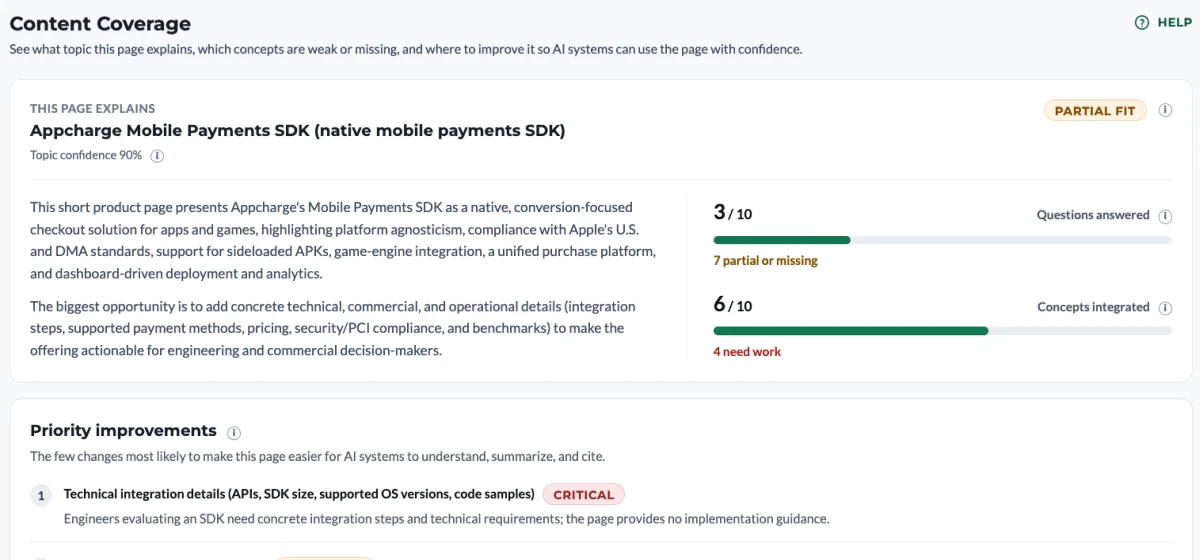
The logic is simple. When someone asks an AI system a question, the system goes looking for sources it can build an answer from. And it doesn’t just check whether an answer exists on the page. It weighs whether the answer can be trusted:
Is the claim explained, or just asserted? Saying your product is fast isn’t the same as explaining what makes it fast. AI systems can only build answers from the second kind of sentence.
Is there evidence behind it? Numbers, benchmarks, case studies, named customers. A claim without any of these reads as marketing, and AI systems discount it the way a skeptical buyer would.
Does it hold up against other sources? AI systems corroborate. A claim that appears on your page and nowhere else carries less weight than one that’s consistent across your docs, reviews, and third-party mentions.
These failure modes are common. In our own audits, 37.9% of pages were flagged too promotional to cite, and 9.3% made claims with no evidence behind them. See the full findings.
These are just some of the factors Content Coverage checks. The scan mirrors how LLMs actually evaluate sources, built from their documentation and from published citation research. And failing these checks costs you.
If your page skips the questions people actually ask, it won’t get picked as a source. If it answers them but only with claims, the citation goes to a page that backs them up.
Because the ranking is grounded in the actual page, the fixes are concrete rather than general advice.
A Live Example: Same Page, ChatGPT VS BeSeenByAI
We took a real product page from a payments platform, Appcharge. The page sells their Mobile Payments SDK to game developers.
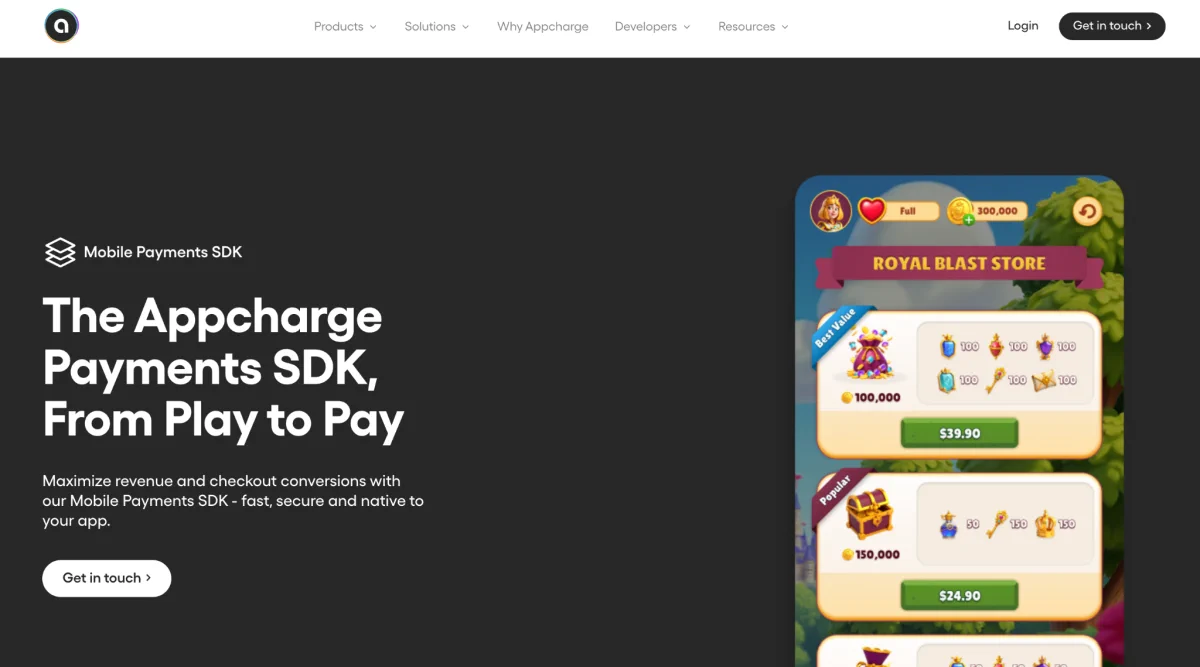
We pasted it into ChatGPT and asked how to make it more visible to AI systems. Then we ran Content Coverage on the same page.
What ChatGPT Said
The answer is genuinely decent. Twelve recommendations. Add explicit questions, add a comparison table, define terms like Merchant of Record, link deeper into the docs, publish unique insights. It even scored the page: 6.5/10 for AI retrievability, 5.5/10 for citability.
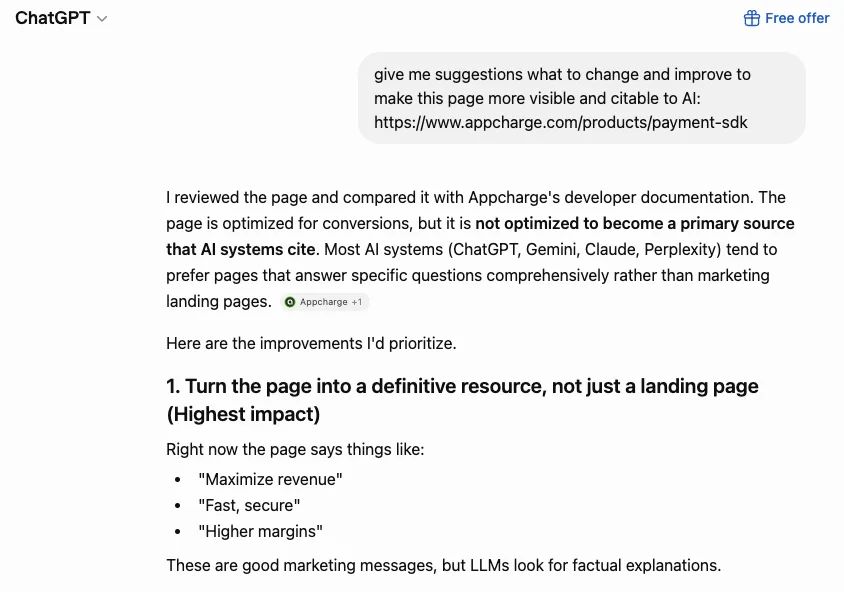
If you’ve never thought about AI visibility before, this reply is a useful education. But look at what it actually is.
It’s a playbook, not an analysis. Paste almost any B2B product page and you’ll get roughly this list. Add FAQs, add tables, add definitions, add diagrams. The advice is real, but it wasn’t derived from what this specific page is missing. ChatGPT never detected the topic, never built the question set a complete page should answer, never checked the page against those questions one by one. It skipped straight to recommendations, which is why the recommendations are generic.
The scores have no analysis behind them. 6.5/10 for retrievability, measured how? Against what question set, what concept map? There’s no methodology under the number, so there’s nothing the number can tell you.
And it missed things. ChatGPT never flagged that the page has no pricing information, even though cost is one of the first questions a buyer asks an AI system about a payments SDK. It also recommended FAQ schema, which the citation research we’ll get to says barely matters. This is what happens when advice comes from patterns instead of from the page: real gaps get missed, and low-impact fixes get equal billing.
What Content Coverage Found
Content Coverage ran the actual analysis on the same page.
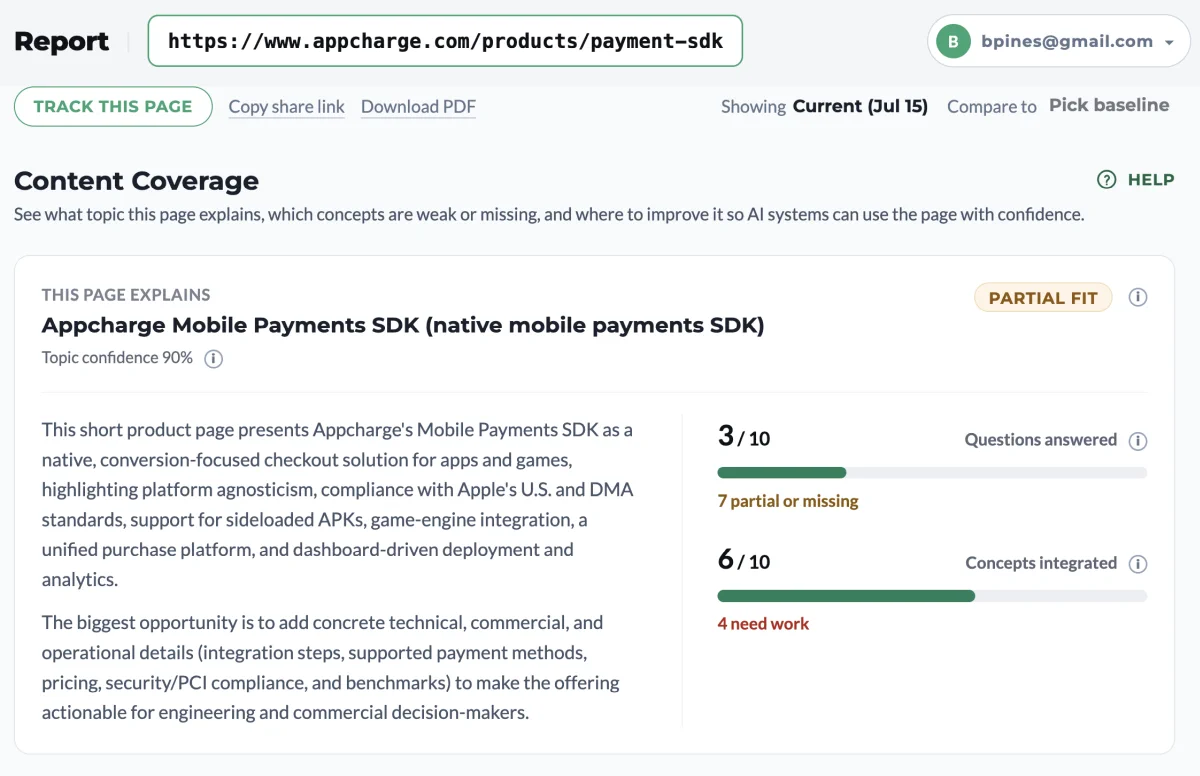
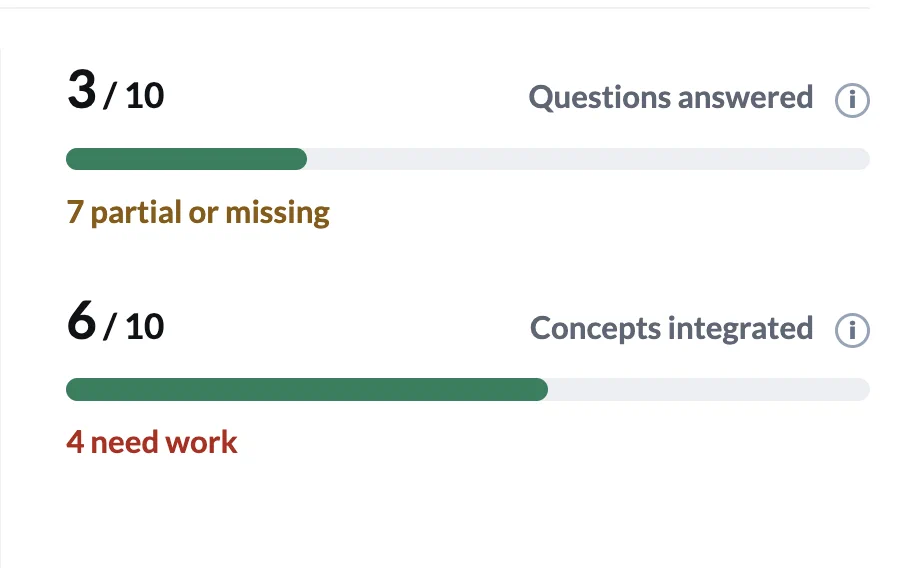
It detected the topic (native mobile payments SDK) with 90% confidence and marked the page a Partial fit. Then it checked the page against the expected question set: 3 of 10 questions answered. 6 of 10 core concepts integrated, with 4 needing work.
The missing questions are the ones a buyer actually asks:
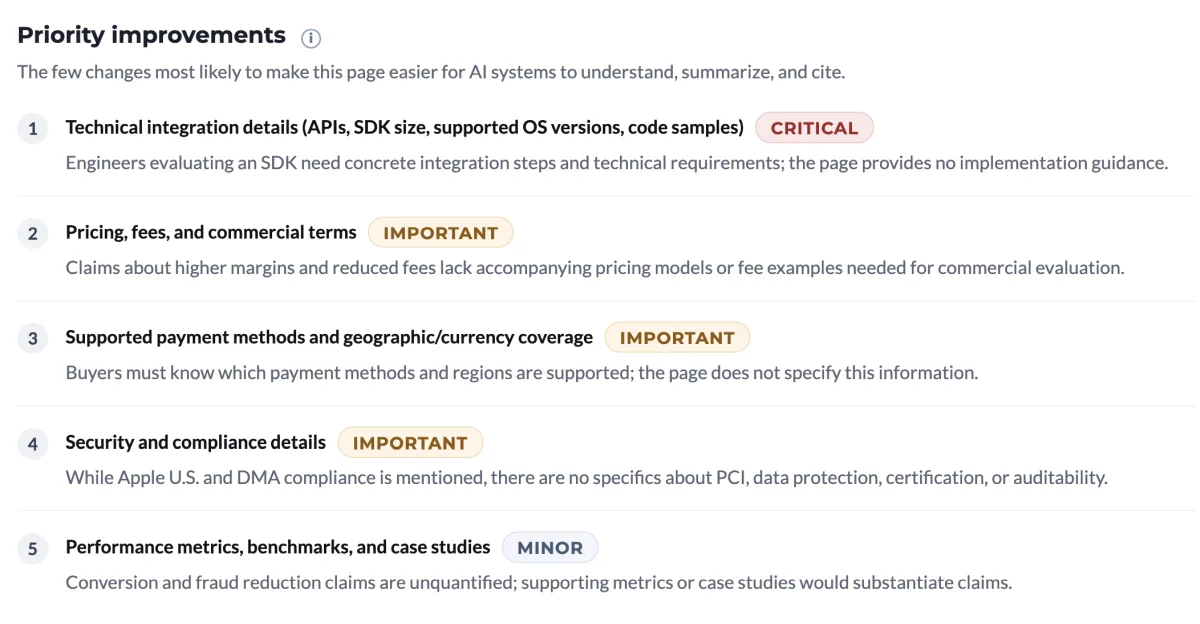
How do I integrate the SDK? No steps, no code samples, no docs linked.
What payment methods, currencies, and regions are supported? Not specified anywhere on the page.
What does it cost? The page claims higher margins and reduced fees, with no pricing model or fee example behind the claim. This is the gap ChatGPT never mentioned.
What are the performance numbers? Conversion and fraud claims appear with no metrics or case studies.
Then the partials. Compliance with Apple’s U.S. and DMA standards is asserted, but with no detail on scope or evidence. The dashboard is mentioned but never shown. Fraud mitigation is claimed but not explained.
Each gap comes back ranked: technical integration details marked Critical, pricing and security marked Important, benchmarks marked Minor. That list is a content brief you can hand to whoever owns the page, and every item on it points at something this page is actually missing. Fix the items, re-run the scan, and the questions-answered count tells you whether the page moved.
The Research Backs This Up
Cyrus Shepard (Zyppy) published an analysis of 54 experiments, patents, and case studies on AI citations, distilled into 23 scored factors across ChatGPT, Gemini, and Perplexity. The top factors: URL accessibility (9.5), search rank (9.4), fan-out rank (9.3), preview controls (9.2), and query-answer match (9.2).
Look at that list. URL accessibility is a crawlability question, and it scores highest. ChatGPT reviewing your pasted content can’t check it at all. Query-answer match is exactly what steps 2 and 3 of Content Coverage measure: does the page contain an answer to the question being asked.
Shepard’s analysis also found that domain authority is only weakly correlated with AI citations, and shorter, tightly focused content is outperforming old-school skyscraper long-form. Focused and complete beats long and impressive. That’s why Content Coverage starts with topic confidence: one page, one topic, explained fully.
A separate academic study went further. A 252,000-trial study of citation preference across six models found a clear hierarchy: topic match dominates as a gatekeeper factor, completeness and trust cues add secondary gains, and formatting has negligible impact.
Formatting is where several of ChatGPT’s twelve recommendations landed (FAQ schema, comparison tables, diagrams). Topic match and completeness are what Content Coverage measures. The evidence says which one decides citations.
Where Content Coverage Fits in Your GEO Flow
To be clear, ChatGPT is useful. It’s good at explaining concepts and drafting the content that fills the gaps. Use it for that. Just don’t use it as the instrument that tells you where the gaps are.
When you are dealing with content optimization for AI visibility, you have to go deeper.
That’s what BeSeenByAI offers.
Content Coverage produces your Answer Readiness score, and paves a clear path to real GEO optimization. For the full walkthrough of how it works, see What is Content Coverage and How to Use It. For a real example, see how an independent SEO & GEO consultant used Content Coverage to close a gap and grow AI citations 4x.
The working loop is short. Run the audit. Fix access and rendering first, because complete content that bots can’t reach doesn’t exist. Then run Content Coverage on the pages that matter: product pages, guides, comparison pages. Fix the Critical and Important items. Re-run and watch the questions-answered count move.
Content Coverage gives you an analysis of your page: the topic, the questions it should answer, which ones it does, and a ranked list of what to fix. AI systems cite pages that pass these checks. Anything more superficial will either be marked as not trustworthy enough to cite, or worse - AI slop.
Go ahead and run a free scan on BeSeenByAI and start optimizing for AI visibility.