The Authority scan is a structural audit that checks whether AI systems can confidently classify your page.
After running the scan, we recommend fixing any failed checks first, then reviewing the warnings to decide which ones are worth addressing.
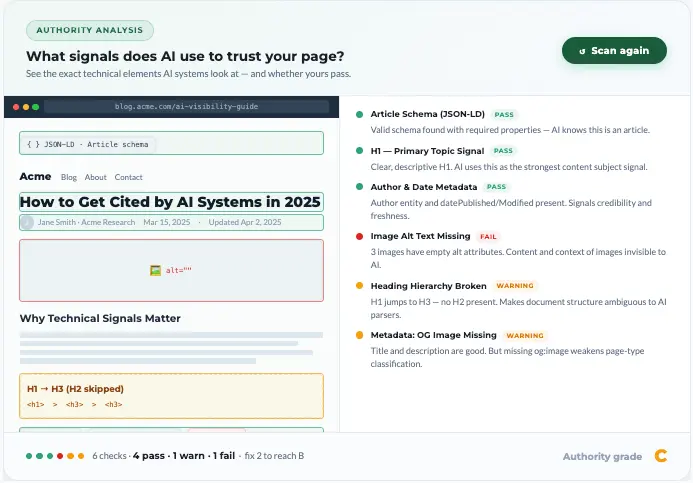
It detects what type of page you have, grades how well it matches the structural expectations for that type, and flags the specific signals that are missing, weak, or contradicting each other. The output is a grade, a list of pass, warning, and fail results, and a clear sense of what to fix first.
Page type sits at the center of this because it is the first thing AI systems try to figure out when they read your page. That classification shapes everything that follows: which prompts your page can answer, how it gets weighted against other sources, and whether AI systems trust it enough to cite. A page can have great content, valid markup, and good performance, and still be passed over because AI systems were not sure what kind of page they were looking at.
This guide walks through how page type recognition works, why it matters, how each common type should be structured, and how to read the grade and severity signals that come back from a page type audit.
Why Page Type Matters
AI systems handle different prompt types differently. A question like “what is the capital of France” expects an informational answer. “Best running shoes under $150” expects commercial sources. “How do I install a dishwasher” expects step by step content.
When classification is clear, your page becomes a candidate for the prompts it is structurally suited to answer. When classification is ambiguous, the page becomes harder to use confidently, and AI systems often skip it in favor of pages whose type is unmistakable.
There is no single signal that determines page type. AI systems pull from several at once, and the more these signals agree, the more confident the classification.
The strongest signal is schema.org markup. When a page declares itself as a Product, an Article, a FAQPage, or a Recipe through JSON-LD, that declaration is the most direct statement of what the page is.
This signal is missing more often than not. Across our own audits, 53% of sites are missing Organization or LocalBusiness schema entirely, and 77.3% fail the authority-badge and credential check. See the full findings.
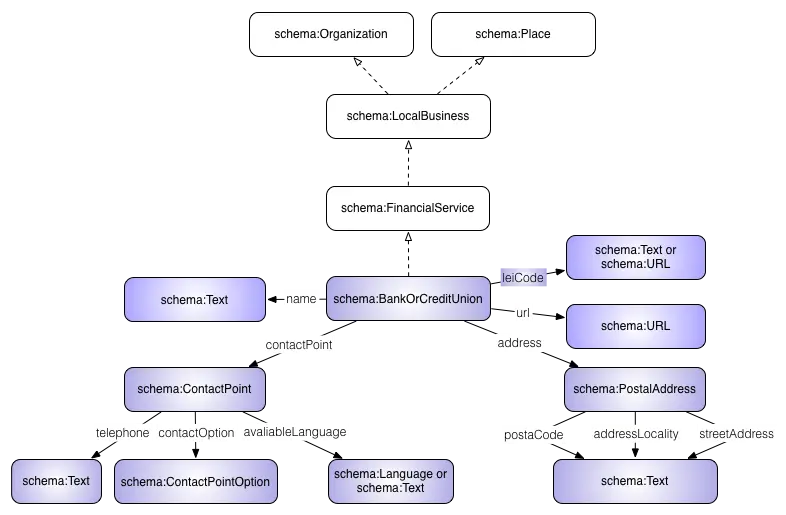
URL patterns are a secondary signal. A URL like /blog/how-to-cite-sources is read differently from /products/wireless-headphones or /faq/shipping.
HTML structure matters too. A page wrapped in an article element with a clear H1 and dated byline reads as editorial content. A page built entirely from generic divs gives AI systems less to work with.
Content patterns add another layer. Ingredient lists suggest recipes. Question and answer blocks suggest FAQs. Pricing tables suggest commerce. These patterns either reinforce the schema declaration or contradict it.
When all four signals agree, classification is confident. When they conflict, AI systems guess, and guessing reduces the page’s usefulness as a citable source.
How Page Type Is Graded
Once your page type is detected, the structure is evaluated against what AI systems expect for that specific type. A Product page is graded against Product expectations. An Article is graded against Article expectations. Each type has its own structural checklist.
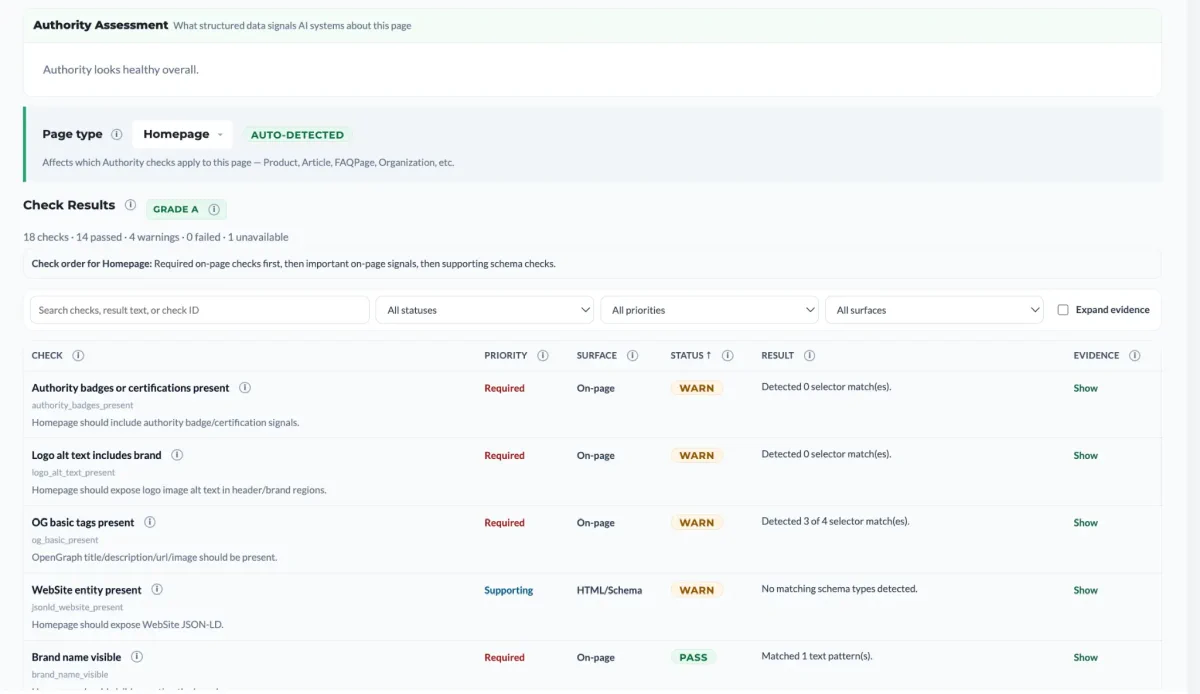
Each check returns one of three results: pass, warning, or fail. Together those results roll up into a grade that tells you how complete your page is for its detected type.
Pass, Warning, and Fail
Pass means the signal is present, valid, and complete. AI systems get a clean, unambiguous read. A pass on schema means the schema is valid, declares the right type, and includes the required properties. A pass on heading structure means the hierarchy is clean and the H1 matches the topic.
Warning means the signal is partially present, below recommendation, or weaker than ideal. The page still functions, but the classification or routing is softened. A common warning is having Article schema with author and date but no dateModified. The signal is there, just incomplete. Warnings rarely block AI systems from understanding the page, but they leave gaps that stronger pages will fill.
Fail means the signal is missing, broken, or actively contradicts the page type. A Product page with no offers object is a fail because the page declares itself commercial without giving AI systems the commercial data. A page with broken heading hierarchy is a fail because the document outline becomes ambiguous. Fails are the highest priority because they remove a critical piece of context AI systems rely on.
The difference between a warning and a fail comes down to severity. Warnings reduce confidence. Fails block clarity. Fix fails first, then warnings.
The Grade
The grade is a weighted aggregate of all the type specific checks. It tells you, at a glance, how structurally complete your page is for the type it has been classified as.
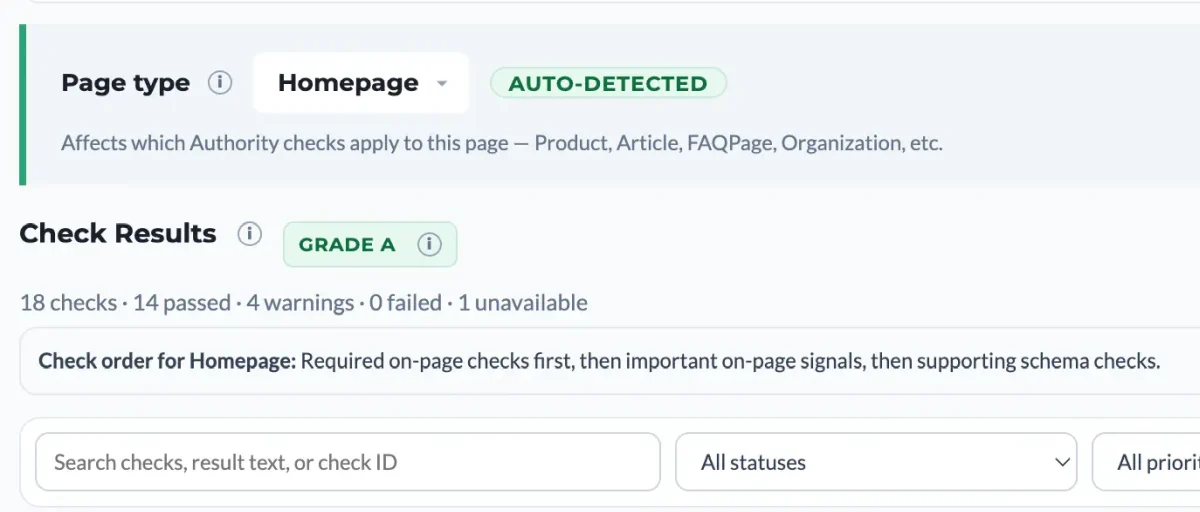
Grade A (90 to 100%) — all major structural signals are present and valid. Schema is complete, hierarchy is clean, required properties are filled in. AI systems can classify and route this page with confidence.
Grade B (80 to 89%) — strong foundation with minor gaps. Required signals are present. Recommended properties or secondary signals may be partially missing.
Grade C (70 to 79%) — moderate completeness. Some required signals are missing or incomplete. Classification is likely correct but routing confidence is reduced.
Grade D (60 to 69%) — significant gaps. Required schema properties may be missing, or the structure may contradict the declared type in places.
Grade F (below 60%) — minimal structural signals for the detected type. AI systems may struggle to classify the page at all, or may classify it incorrectly.
The grade is type specific. A page with no schema and a generic template may grade well as a “general web page” but poorly when evaluated against the type it was meant to be. The grade reflects how complete the page is for its detected purpose, not just how much markup exists.
Required schema properties and the primary type declaration move the grade the most. Optional properties and secondary metadata move it less. Fix the foundational signals first and the grade will respond.
The 21 Page Types
The tool recognizes 21 distinct page types, each with its own structural expectations:
Homepage, About Page, Contact Page, Article and Blog Post, News Article, Landing Page, Product Page, Category Page, Comparison Page, Case Study, Pricing Page, Service Page, FAQ Page, How To and Tutorial, Recipe, Review Page, Documentation Page, Glossary and Definition Page, Event Page, Careers Page, and Video Page.
Each type has its own checklist. A Product page is evaluated against Product expectations, not Article expectations. A Recipe is evaluated against Recipe expectations. The structure that earns an A on one type may earn a D on another. This is what makes page type recognition different from a generic schema check: the audit knows what your page is supposed to be and grades it against that specific standard.
Pass Example: Article Schema Complete
Here is an example of how the system might pass one of the check items.
A blog post with BlogPosting schema, author entity, datePublished, dateModified, headline matching H1, and featured image with alt text. Every required property is present and validates cleanly.
{
  "@type": "BlogPosting",
  "headline": "How AI Systems Read Your Page Structure",
  "author": { "@type": "Person", "name": "Jane Smith" },
  "datePublished": "2025-03-15",
  "dateModified": "2025-04-02"
}
Why it passes: All required properties are present and the schema content matches the visible page. AI systems classify this as an editorial article with high confidence.
Warning Example: Article Missing dateModified
An article with valid BlogPosting schema, author, datePublished, headline, and image, but no dateModified property.
{
  "@type": "BlogPosting",
  "headline": "...",
  "author": {...},
  "datePublished": "2024-08-12"
}
Why it warns: The article is classifiable and complete enough for routing. But without dateModified, AI systems have no signal about freshness, which weakens the page against more recently updated competitors.
A Practical Sequence for Fixing Page Type Issues
The audit gives you a grade, a list of checks, and a severity for each one. The most efficient way to work through them is:
- Fix fails first. Fails block classification or remove critical context. They have the highest impact on the grade and on routing.
- Then fix warnings. Warnings reduce confidence rather than blocking it, but they accumulate. Several warnings on the same page weaken the overall signal.
- Audit at the template level when possible. Most page type issues are template issues. Fixing the template fixes every page built on it.
- Recheck the grade. Required schema properties and the primary type declaration move the grade the most. Optional properties move it less.
Type clarity is mostly mechanical work, and most of it is permanent once it is done. A page that grades A on its type stays A unless the template changes.
For the checks where the fix is a block of markup (a missing schema property, an absent JSON-LD declaration), Optimizations drafts the snippet for you, built from what the page already states, so you paste a valid block instead of hand-writing schema.